Yes, you can rekey some locks yourself, and how to rekey a lock comes down to the brand: a Kwikset SmartKey cylinder needs only its working key, the SmartKey tool and a new key, and a standard Schlage pin tumbler lock can be repinned with the matching Schlage kit if you work slowly and the lock is in good shape. Doing it yourself makes sense for one or two sound, brand-matched locks in a home you own. It does not make sense for a rental turnover in Washington, an older Tacoma house with original mortise locks, a smart lock, a high-security cylinder, or any lock that already binds; those are jobs for a residential locksmith, who keys every door to one key in a single visit and quotes the job upfront.
- Rekey it yourself if: the lock is a Kwikset SmartKey with a working key, or a sound Schlage cylinder, you own the home, and one key per door is acceptable.
- Call a locksmith if: the keys are lost, the brands are mixed, the property is a rental, the door is pre-1940, the lock is smart or high-security, or the key already drags.
- Either way: test every lock with the door open before you close it.
Can you rekey a lock yourself? What rekeying means
Rekeying a lock changes the pins inside the cylinder so a new key operates it and the old keys stop working, while the knob, deadbolt and trim stay on the door. Replacing a lock swaps the whole unit. How to rekey a lock depends entirely on the brand: Kwikset SmartKey cylinders reprogram with a tool and no disassembly, Schlage and most other pin tumbler cylinders are repinned by hand from a brand-specific kit, and mortise, smart and restricted-keyway locks each follow their own path. The steps below cover the two kinds a homeowner can rekey; the rest of the article covers the ones a homeowner should not.
What you need before you start
For a Kwikset SmartKey lock you need three things: the key that currently works the lock, the SmartKey tool that shipped with it (a replacement can be ordered from Kwikset), and a new key cut on the same keyway. Kwikset’s standard SmartKey cylinders take the Kwikset KW1 keyway; the SC1 version of SmartKey takes a Schlage C keyway and the rekey hole sits on the opposite side of the keyway. Without the working key there is no DIY path. Kwikset’s own instructions start with the current key in the lock.
For a Schlage pin tumbler lock you need the Schlage keying kit (kit 40-132 covers the common knobs, levers and B-Series deadbolts; 40-134 is the smaller knob and lever kit). The kit holds bottom pins, top pins, springs, cylinder caps, a key gauge, a plug follower and a cap removal tool. You also need the key you are rekeying to, cut in advance by a hardware store or locksmith, because the new bottom pins are chosen to match its cuts. A pinning kit for one brand does not fit another brand’s plug.
How to rekey a Kwikset SmartKey lock, step by step
These are the SmartKey steps on Kwikset’s current support page. Older SmartKey locks shipped with a sheet that ends the new-key rotation at 90 degrees instead of the 180 and 180 in step 6; if your lock’s printed sheet differs, follow the sheet, because the pull test in step 7 is the same on both. Work with the door fully open so you cannot lock yourself out, and set the deadbolt or latch to the locked position first.
- Insert the key that currently operates the lock.
- Rotate that key 90 degrees clockwise.
- Insert the SmartKey tool fully and firmly into the SmartKey hole until you feel it click inside the lock.
- Remove the SmartKey tool, then remove the current key.
- Insert the new key and make sure it is fully inserted.
- Without pushing or pulling on the key, rotate it 180 degrees counterclockwise, then 180 degrees clockwise.
- Pull on the key to confirm it will not come out in this position. If it comes out, the rekey did not take; start again from step 1.
- Rotate the key 90 degrees counterclockwise back to the starting position and remove it.
- Test the new key with the door open, then closed, and confirm the old key no longer turns the lock. Repeat for every SmartKey cylinder in the house.
How to rekey a Schlage pin tumbler lock with a kit, step by step
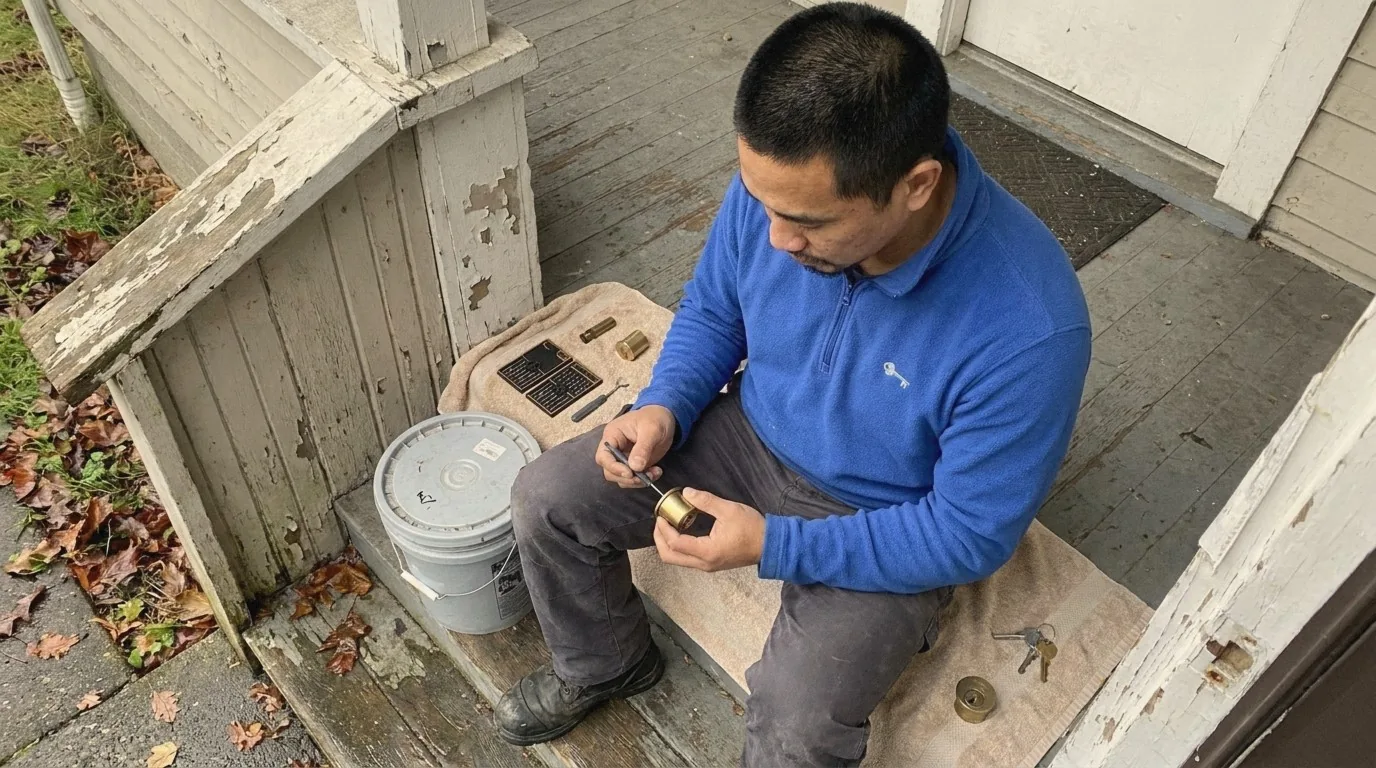
This is the order in Schlage’s rekeying manual for F-Series knobs and levers; B-Series deadbolts follow the same cylinder steps after the cylinder comes out of the thumbturn housing. Work over a tray, because a cylinder that lets go sends five springs and five top pins across the porch.
- Insert the key and rotate it 90 degrees. Press the knob or lever catch with the tab on the key gauge and pull the knob off, then pull the rose and knob off the spindle. Rotate the key back and remove it.
- With the keyway facing up, tilt the tail of the cylinder down and push the cylinder out through the back of the knob. Schlage’s manual states that this needs no more than 5 pounds of force, “the amount of force required to push an elevator button”; if it needs more, the cylinder is misaligned, so realign it rather than force it.
- Use the U-shaped end of the key gauge to remove the C-clip retaining ring from the back of the plug.
- Insert the old key, turn it 90 degrees, and push the plug follower into the rear of the housing in one careful, continuous motion so the plug exits the front. The follower stays in the housing to hold the top pins and springs in place.
- Dump the old bottom pins from the plug and discard them along with the old keys.
- Read the new key’s cut depths with the key gauge (or the numbers stamped on the key bow), insert the new key fully, and load the matching bottom pins pointed end down. Every pin must sit flush with the top of the plug, forming a straight shear line; any pin above or below the surface gets swapped for the correct size.
- Push the plug back into the housing, driving the follower out the back, and refit the C-clip.
- Reinsert the cylinder into the knob, align the cap with the slot in the sleeve, slide the knob onto the spindle until the catch pops into its slot, and test the new key from both sides with the door open and closed.
Where DIY rekeys go wrong
The DIY rekey failures that turn into locksmith calls in Tacoma and Pierce County fall into six groups, and every one of them is avoidable.
- SmartKey misprogramming. Kwikset’s support pages list three causes when neither the old nor the new key works afterward: the new key was not fully inserted, it was pulled while rotating back to the home position, or it was pushed in, up or down during that rotation. A misprogrammed SmartKey cylinder needs Kwikset’s recovery procedure or a locksmith’s reset tool; pulling on the new key before turning it home, with the door still open, is what catches the problem before it becomes a lockout.
- SmartKey with no working key. If every key is lost, the SmartKey tool alone cannot rekey the lock. The cylinder has to be reset with a locksmith’s cradle tool or replaced.
- Pins and springs out of the housing. Pushing the follower in stops and starts, or pulling it out early, lets the top pins and springs spring out. Schlage’s manual devotes a page to reinserting disengaged pins and springs for a reason.
- Forcing a misaligned cylinder. Schlage’s 5-pound rule is the limit: if a knob cylinder needs more than elevator-button pressure to come out, it is not lined up, and forcing it damages the cap or the knob sleeve.
- Wrong keyway or wrong brand. A Kwikset KW1 key will not rekey into a Schlage C keyway and the reverse is also true, so a mixed house cannot be keyed alike with one kit. A Schlage kit’s pins do not fit a Kwikset, Defiant or Baldwin plug.
- Corroded or worn locks. On a lock that already drags, repinning puts fresh pins against a worn plug and the key still sticks. Tacoma’s wet season corrodes exterior cylinders long before a kit is opened, so run the drag test described under Moisture and corrosion first.
DIY rekey kit vs locksmith: a comparison
| Factor | Rekey it yourself | Call a Tacoma locksmith |
|---|---|---|
| Time | One short session per lock once the tool and a pre-cut key are in hand; longer on a first pin tumbler attempt, plus a trip to get keys cut | One visit for the whole house; keys cut on site from the van |
| Tools | SmartKey tool, or a brand-specific pinning kit with follower and key gauge | Pinning kits for every residential brand, key machine, plug followers, cradle reset tools |
| Keyed alike (one key for every door) | Only when every lock shares one keyway (all KW1 or all SC1) | Mixed brands are swapped or re-cylindered so one key runs the house |
| High-security locks | Not possible: Medeco, Mul-T-Lock and other restricted keyways are rekeyed only by authorized dealers | Peak Locksmith refers restricted keyways to the authorized dealer and handles everything else |
| Smart locks | Kwikset Halo uses SmartKey; Schlage Encode is rekeyed only by swapping its 5-pin C-keyway cylinder (part 29-273 on BE489 and BE499 deadbolts, 29-018 on the FE789 lever) | Cylinder swap plus code and app cleanup in the same visit |
| Rentals | Tenant needs the lease to allow it; landlord still needs a key for lawful entry | Turnover rekey with an invoice for the file and the deposit statement |
| Cost | Kit and key blanks, plus any lock you damage | Quoted upfront by phone before dispatch; no charge to find out |
Read the table as a decision rule, not a verdict. A homeowner in Puyallup with two Kwikset SmartKey deadbolts and both keys in hand has a DIY job. A duplex in Tacoma with a Schlage front deadbolt, a Kwikset knob on the back door and a tenant moving out next week does not.
Tacoma and Pierce County specifics
Rentals and Washington landlord rules
Washington’s Residential Landlord-Tenant Act sets the frame for any rental rekey in Tacoma. RCW 59.18.060 requires the landlord to provide reasonably adequate locks, furnish keys to the tenant, and safeguard any master or duplicate keys. RCW 59.18.290 makes it unlawful to lock a tenant out of the premises except under a court order, so a rekey on an occupied unit without the tenant’s keys is not a DIY project or a locksmith project; it waits until the tenant has vacated.
For a tenant in Washington, no statute grants a right to rekey; the lease decides, and because RCW 59.18.150 preserves the landlord’s right to enter with proper notice, a tenant who rekeys should expect to hand over a copy of the new key. One exception is written into the Act: under RCW 59.18.585, a tenant holding a court order that grants possession to the exclusion of a co-tenant can require the landlord to change or rekey the lock, at the tenant’s expense, once the landlord has a copy of the order.
This section is general information, not legal advice; check the current RCW text or ask an attorney about a specific tenancy. Landlords and property managers get the full turnover sequence, including the Tacoma Rental Housing Code certification that the guide explains, in rekeying a rental property in Washington.
Older Hilltop and North End homes with mortise locks
Consumer rekey kits are built for modern Kwikset and Schlage knob, lever and deadbolt cylinders, and a large share of Tacoma’s older housing carries nothing of the kind. The North Slope Historic District on the North End (National Register reference 03000160) holds 1,285 listed resources, with nearly 80 percent of its homes built before 1930 in three building booms from 1888 to 1929. Hilltop’s South J Street Victorian Row dates to 1889 and 1890. Front doors from that era usually carry a mortise lock with a pin tumbler cylinder screwed into the lock body, while back and interior doors often have bit-key (skeleton key) lever locks.
A mortise cylinder on an older Tacoma door can be rekeyed, but it comes out with a set screw and a cylinder wrench rather than a knob catch, and the cylinders on the oldest doors are often Corbin, Russwin, Sargent or Yale keyways that no big-box kit covers. A bit-key lever lock cannot be rekeyed with any consumer kit at all; the options are a locksmith who can re-lever it, a new mortise body with a modern cylinder in the same pocket, or a separate deadbolt above it. Peak Locksmith rekeys and replaces mortise cylinders on North End, Hilltop, Stadium District and Old Town doors without changing the original trim.
Moisture and corrosion
Tacoma averages 40.81 inches of precipitation and about 155 days a year with measurable rain under the 1991 to 2020 NOAA normals, and that moisture gets into exterior cylinders, especially on doors facing Commencement Bay and the Sound. In a wet cylinder the brass bottom pins and the plug pick up oxidation and grit, the springs weaken, and a lock that still turned with the old worn key refuses the sharp new one after a DIY repin. Before buying a kit, cycle each lock with its current key: if the key drags, sticks at the end of its travel, or needs a wiggle to come out, the cylinder needs cleaning or replacement, not just new pins. A dry PTFE lock lubricant is the right product afterward; heavy oils collect grit over the wet months.
When to call a pro
Call a locksmith instead of opening a kit in these situations, which Peak Locksmith handles across Tacoma, Lakewood, University Place, Puyallup, Federal Way, Fife and the rest of Pierce County:
- No working key for a SmartKey lock, or a SmartKey cylinder that neither key turns after an attempt.
- More than two or three doors, or a mix of Kwikset and Schlage locks that you want on one key.
- A rental turnover, where you want the unit done between tenants and an invoice for the file.
- A mortise lock, a bit-key lock, or any lock on a pre-1940 door in the North End, Hilltop or Old Town.
- A smart lock, commercial-grade or Grade 1 hardware, or any restricted keyway (Medeco, Mul-T-Lock).
- A lock that already binds, drags or shows green corrosion on the plug face.
- Any situation where the old key may be in the wrong hands and you need every door changed right away.
Every Peak Locksmith rekey is quoted upfront by phone before a technician is dispatched. If you are still deciding whether to repin or replace the hardware, read rekey vs. replace locks for Tacoma homeowners, or call (253) 262-5630 and describe the doors and brands you have.
Frequently Asked Questions
Can I rekey a lock myself without the original key?
Not with a consumer kit. A Kwikset SmartKey lock cannot be rekeyed by the owner without a working key, because Kwikset’s procedure begins with the current key in the lock. A standard pin tumbler lock must be picked, shimmed or drilled before its plug will come out for repinning, which is a locksmith job. Both cases are a locksmith call.
Can I use a Kwikset rekey kit on a Schlage lock?
No. Kwikset SmartKey locks are rekeyed with the SmartKey tool, not a pin kit, and Schlage cylinders take Schlage pins sized to the Schlage C keyway. Each brand’s kit fits its own plug, and a KW1 key and an SC1 key cannot be made to operate the same cylinder.
Can a tenant rekey the locks in Washington?
Only if the lease allows it, and the landlord keeps a right of entry with notice under RCW 59.18.150, so the tenant should provide a key. A tenant holding a court order that excludes a co-tenant can require a lock change under RCW 59.18.585 at the tenant’s expense. Landlords may not rekey an occupied unit to exclude a tenant (RCW 59.18.290).
Is rekeying as secure as replacing the lock?
A correct rekey makes the old keys useless and is as secure as the lock hardware was to begin with. It does not upgrade a builder-grade knob to a Grade 1 deadbolt, and it does nothing for a lock that is worn, corroded or loose in the door. Replace in those cases; rekey when the hardware is sound and only key control has to change.
About Peak Locksmith
Peak Locksmith is a locally owned and insured mobile locksmith company based in Tacoma, Washington (98409), serving Pierce County including Lakewood, University Place, Puyallup, Federal Way and Fife. Technicians respond 24 hours a day, 7 days a week for car lockouts, home lockouts, rekeying, lock installation and repair, car key duplication, key fob programming and commercial access control. Every job is quoted upfront by phone before dispatch. Peak Locksmith LLC is a registered Washington State contractor (L&I registration PEAKLLL788MG, Locks, Security and Alarm Equipment). Reach Peak Locksmith any time at (253) 262-5630.
Published October 26, 2026. Sources checked October 2026: Kwikset SmartKey re-keying support; Kwikset, neither key works after rekeying; Locksmith Ledger, Kwikset SmartKey SC1 keyway; Schlage Rekeying Manual, kits 40-132 and 40-134; Schlage Encode cylinder replacement; RCW 59.18.060; RCW 59.18.150; RCW 59.18.290; RCW 59.18.585; North Slope Historic District; Hilltop, Tacoma; Locksmith Ledger, A History of Locksmithing; NOAA NCEI U.S. Climate Normals 1991 to 2020 (Tacoma figures as tabulated on Tacoma, Washington). Last reviewed October 26, 2026.